
Keto Fruits List: Best Low-Carb Fruits to Eat (and Which to Limit)
Fruit can feel confusing on keto. Some fruits are relatively low in carbohydrate and can fit into a ketogenic eating pattern, while others can use a large portion of your daily carbohydrate intake in a relatively small serving.
That does not mean fruit has to be treated as simply “keto” or “not keto.” The more useful question is how much carbohydrate a particular fruit provides, how much you actually eat, and how that portion fits into your overall carbohydrate intake for the day.
This is especially important when comparing fruits that appear similar at first glance. A small serving of berries may fit comfortably into your routine, while a similar-sized serving of a higher-carbohydrate fruit can use considerably more of your available carbohydrate budget.
In this guide, you’ll find a practical keto fruits list organized around carbohydrate content, net carbs, portion size, and serving context. The goal is not to label every fruit as either good or bad, but to help you understand which fruits are easier to fit into a low-carb routine and how to make informed choices based on your own needs.
Key Takeaways
- Fruit is not automatically off-limits on keto. The key consideration is how much carbohydrate the fruit contributes and whether that amount fits your overall intake.
- Lower-carb fruits are generally easier to fit into a keto routine. Berries, avocado, and some other fruits provide options when carbohydrate intake needs to remain relatively low.
- Portion size matters. Even a relatively lower-carb fruit can contribute a meaningful amount of carbohydrate when the serving becomes large.
- Net carbs can help when comparing fruits. Looking at carbohydrate in relation to fiber gives you another useful way to evaluate a serving.
- Higher-carb fruits may require smaller portions or may not fit your particular carbohydrate budget. The practical decision depends on the fruit, the amount eaten, and what else you are eating that day.
- The goal is not to find a single “best” fruit. It is to choose portions and fruit types that fit your own keto carbohydrate budget and eating pattern.
How Fruit Fits Into a Keto Carb Budget
Whether a fruit fits into your keto routine depends less on its label and more on how much carbohydrate it contributes to your overall diet.
Fruit contains naturally occurring carbohydrate, but the amount varies considerably from one type to another. Portion size also matters. A fruit that is relatively low in carbohydrate can still contribute a meaningful amount if you eat a large serving, while a higher-carbohydrate fruit may be possible in a smaller portion for some people.
Carbohydrate Content Matters
When choosing fruit on keto, start by checking its carbohydrate content rather than assuming that all fruit should be avoided.
Lower-carbohydrate options generally give you more flexibility because they use less of your available carbohydrate intake. Higher-carbohydrate fruits require more attention to portion size because a relatively small serving can account for a larger share of your daily intake.
The goal is not to find fruit with absolutely no carbohydrate. It is to understand the contribution of the fruit you are actually planning to eat.
Portion Size Changes the Equation
The amount you eat can be just as important as the type of fruit.
Nutrition information is often presented for a standard weight such as 100 grams, but the portion you put in a bowl may be larger or smaller than that reference amount. This means two people can eat the same fruit while consuming very different amounts of carbohydrate.
For that reason, use carbohydrate values as a guide rather than assuming that a food’s classification applies regardless of portion.
Consider the Rest of Your Day
Fruit does not need to be evaluated in isolation.
A serving may fit comfortably into your eating pattern on one day but become harder to accommodate on another day when other foods have already used more of your available carbohydrate intake.
Think of fruit as one part of your overall carbohydrate budget. The practical question is:
How much carbohydrate does this portion add, and does it fit alongside everything else I plan to eat?
Keto-Friendly Does Not Have to Mean Unlimited
Calling a fruit “low carb” or “keto-friendly” does not mean you can eat unlimited amounts of it.
Even lower-carbohydrate fruits can add up when portions become large. On the other hand, a fruit that is higher in carbohydrate does not necessarily need to be treated as universally forbidden if a small portion can fit within the individual’s overall approach.
This is why portion awareness is more useful than relying on a simple list of allowed and forbidden fruits.
A More Practical Way to Think About Fruit on Keto
Instead of asking:
“Is this fruit keto?”
ask:
“How much carbohydrate will this portion give me, and how does that fit into my overall keto carbohydrate intake?”
That question gives you a more flexible way to choose fruit while still keeping carbohydrate management at the center of the decision.
Keto Fruits List: Quick Reference
The easiest way to compare fruits on keto is to look at their carbohydrate content alongside the amount you actually plan to eat.
The table below uses approximate net carbohydrate values per 100 grams as a consistent reference point. Actual values can vary somewhat depending on the variety, ripeness, and source. The practical portion matters just as much as the number per 100 grams.
| Fruit | Approx. Net Carbs per 100g | General Keto Fit |
|---|---|---|
| Avocado | ~2g | Easier to fit |
| Blackberries | ~5g | Easier to fit |
| Raspberries | ~5g | Easier to fit |
| Strawberries | ~6g | Easier to fit |
| Lemon | ~6g | Easier to fit in small portions |
| Lime | ~7g | Easier to fit in small portions |
| Blueberries | ~12g | More portion-sensitive |
| Orange | ~9g | More portion-sensitive |
| Watermelon | ~7g | More portion-sensitive |
| Apple | ~11g | Higher-carb |
| Pineapple | ~11g | Higher-carb |
| Cherries | ~13g | Higher-carb |
| Mango | ~14g | Higher-carb |
| Grapes | ~17g | Higher-carb |
| Banana | ~20g | Higher-carb |
These figures are intended as a comparison tool rather than a precise prescription. USDA FoodData Central provides food-composition data on an edible-weight basis, but nutrient values can vary among food samples and datasets.
How to Use This Table
The numbers become more useful when you combine them with portion size.
For example, a fruit with about 5 grams of net carbohydrate per 100 grams gives you considerably more flexibility than a fruit with about 20 grams per 100 grams. But eating 200 grams instead of 100 grams doubles the carbohydrate contribution.
That is why the table should not be interpreted as a list of unlimited “good” fruits and forbidden fruits.
Instead, use it to identify which fruits generally require less carbohydrate budget for a given amount and which ones require more careful portion control.
A Quick Rule of Thumb
If you want fruit while keeping carbohydrate intake relatively low:
- Start with lower-carb options when you want a more generous portion.
- Use moderate-carb fruits more carefully, especially when other foods have already used a significant portion of your daily carbohydrate intake.
- Treat higher-carb fruits as more portion-sensitive rather than automatically assuming they can never be eaten.
- Check the actual portion you eat, rather than relying only on a per-100-gram comparison.
The goal is not to find one universally “best” fruit. It is to choose a fruit and portion that make sense within your overall carbohydrate budget.
Best Lower-Carb Fruits for Keto
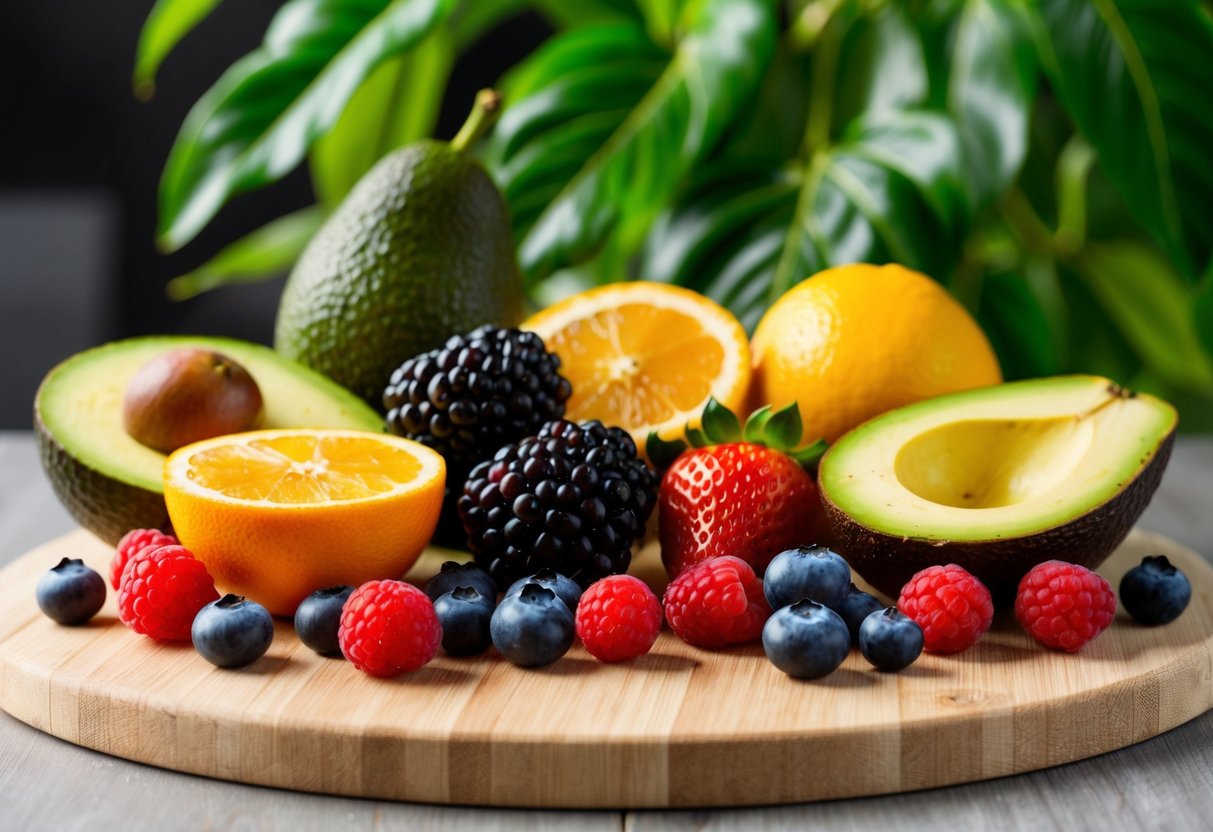
When you want to include fruit while keeping carbohydrate intake relatively low, some choices are easier to work into a keto eating pattern than others.
Lower-carb fruits give you more flexibility because a reasonable portion generally uses less of your available carbohydrate intake. That does not make them unlimited, however. The amount you eat still matters.
Avocado
Avocado is one of the most carbohydrate-efficient fruits commonly used in keto meals.
It contains relatively little net carbohydrate compared with many other fruits and also provides fiber and fat, which makes it quite different from sweeter fruits such as bananas, grapes, or mangoes.
Avocado can therefore be useful when you want to include a fruit in a meal without using a large portion of your carbohydrate budget.
It also works in both savory and sweet applications, making it relatively easy to incorporate into different meal patterns.
The important point is still portion size. Even a lower-carb fruit should be considered as part of your overall daily intake.
Raspberries
Raspberries are one of the lower-carbohydrate berry choices
Their relatively high fiber content means their net carbohydrate amount is lower than their total carbohydrate amount, making them a practical option when you want a sweet fruit while keeping carbohydrate intake relatively controlled.
They can be eaten on their own or incorporated into a meal or snack.
As with any fruit, however, a large serving contributes more carbohydrate than a small one. The fact that raspberries are relatively low in net carbs does not make portion size irrelevant.
Blackberries
Blackberries are another useful option for a lower-carbohydrate fruit selection.
Like raspberries, they provide fiber along with naturally occurring carbohydrate. This makes them easier to fit into many low-carb eating patterns than fruits with substantially higher carbohydrate density.
Blackberries can work well when you want fruit as part of a snack, breakfast, or meal without using as much of your carbohydrate budget as some higher-carb choices would require.
Strawberries
Strawberries can also fit into a keto eating pattern, particularly when the portion is kept appropriate for your overall carbohydrate intake.
They are useful when you want a familiar, relatively lower-carbohydrate fruit without relying only on berries with smaller individual pieces.
Because strawberries are often eaten in larger bowls or combined with other foods, it is still worth considering the total amount rather than treating them as a free food.
Lemon and Lime
Lemon and lime are different from fruits that are typically eaten by the handful or by the bowl.
They are usually used in much smaller quantities, which means their contribution to total carbohydrate intake can be relatively modest when used as flavoring.
This makes them practical additions to drinks, dressings, sauces, and meals when you want citrus flavor without consuming a large serving of fruit.
The same principle applies here: the relevant factor is how much you actually consume, not simply whether the fruit itself is considered low carb.
Other Lower-Carb Options
There are other fruits that can sometimes fit into a low-carbohydrate eating pattern, but they should still be evaluated according to their carbohydrate content and the portion you plan to eat.
This is why a useful keto fruit list should not simply create a permanent category of “allowed” fruits.
Instead, use the carbohydrate comparison as a starting point, then consider the actual serving and how it fits with the rest of your day’s intake.
What Makes These Fruits Easier to Fit?
The common feature is not that these fruits are somehow “keto foods” by definition.
It is that their carbohydrate contribution can be relatively modest in an appropriate portion compared with many higher-carbohydrate fruits.
That gives you more flexibility when building a keto meal pattern.
The practical approach is therefore simple:
Choose the fruit you want, check its carbohydrate content, decide on a realistic portion, and account for that portion within your overall carbohydrate intake.
Lower-carb fruits simply give you more room to work with.
High-Carb Fruits to Limit on Keto
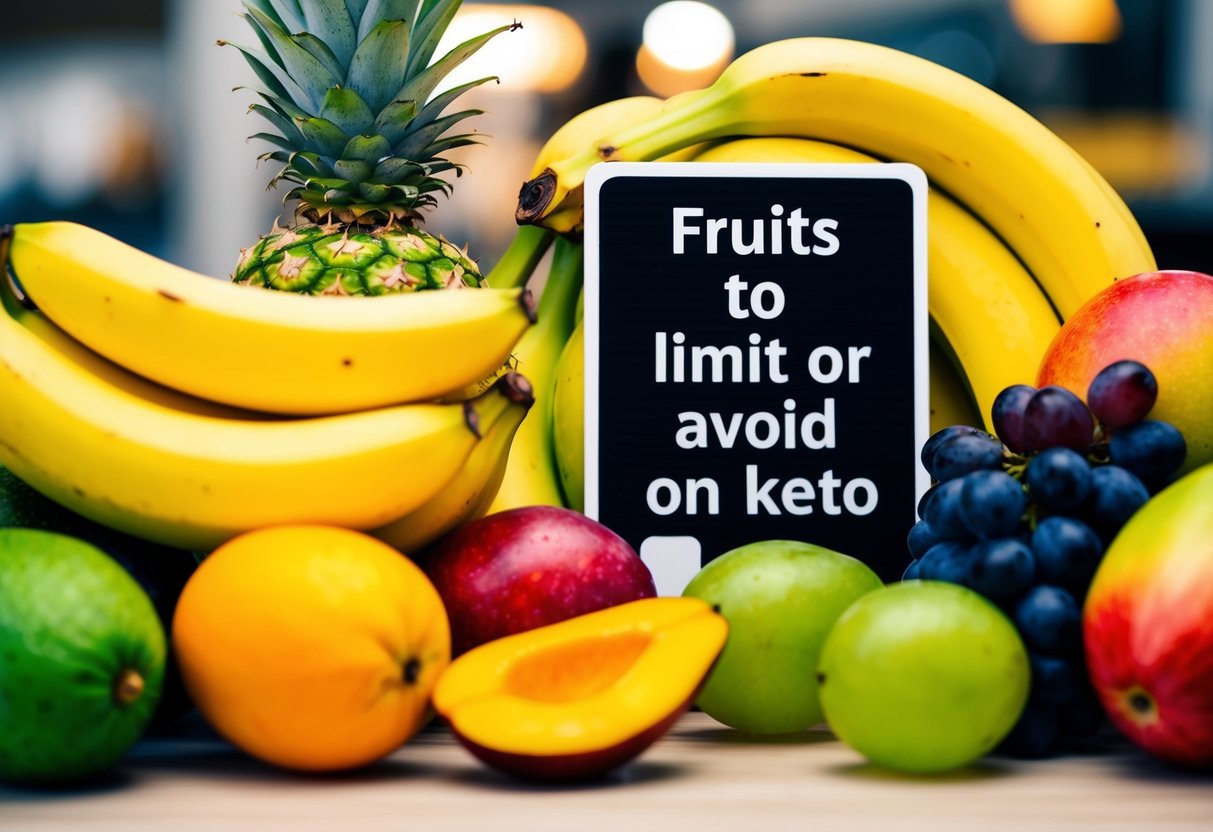
Some fruits contain considerably more carbohydrate than the lower-carb options discussed above. That does not necessarily mean they can never be eaten on keto, but it does mean that portion size becomes more important.
A relatively small serving of a higher-carbohydrate fruit can use a substantial portion of the carbohydrate you have available for the rest of the day. For someone following a very low-carbohydrate approach, that can make these fruits harder to include regularly.
Bananas
Bananas are relatively high in carbohydrate compared with berries and avocado.
A whole banana can therefore account for a substantial amount of carbohydrate in a single serving, particularly when compared with lower-carb fruit options.
If you want to include banana while keeping carbohydrate intake low, the practical issue is portion size. A smaller amount may fit more easily than a whole banana, depending on your overall carbohydrate intake.
Grapes
Grapes can be easy to overeat because they are small and convenient to snack on.
The carbohydrate content can add up quickly when you eat a handful after another without paying attention to the total amount.
If grapes are part of your diet, measuring or consciously limiting the portion can make their carbohydrate contribution easier to account for.
Mango
Mango has considerably more carbohydrate than many of the berries commonly used on keto.
Because mango is often eaten in chunks or larger portions, the amount can add up quickly. A smaller portion may be easier to accommodate than a typical large serving.
The important question is not whether mango is permanently off-limits, but whether the amount you want to eat fits within your overall carbohydrate budget.
Apples
Apples are another fruit that can require more portion awareness on keto.
A whole apple provides substantially more carbohydrate than a comparable amount of lower-carb berries. If you choose to include it, consider the actual portion rather than assuming that one whole fruit is automatically an appropriate serving for a very low-carbohydrate diet.
Pineapple
Pineapple can also contribute a meaningful amount of carbohydrate in a relatively small serving.
It may therefore be more difficult to fit into a strict low-carbohydrate routine than lower-carb fruits. If you enjoy pineapple, a measured portion can help you understand exactly how much of your carbohydrate budget it uses.
Cherries
Cherries are another fruit where portion size deserves attention.
Because they are small and easy to eat individually, it can be surprisingly easy for the total portion to become larger than intended.
Counting or measuring the amount you eat can make it easier to include cherries deliberately rather than consuming a large portion without realizing how much carbohydrate it provides.
Higher-Carb Does Not Mean Automatically Forbidden
The main reason to limit these fruits on keto is their carbohydrate density, not because natural sugar makes them inherently unhealthy.
A higher-carbohydrate fruit simply gives you less room within a low-carbohydrate eating pattern.
For example, someone may decide that a small portion of a favorite higher-carb fruit is worth including, while another person may prefer to spend that same carbohydrate allowance on a larger serving of berries.
Both decisions can be reasonable depending on the individual’s dietary approach.
The useful distinction is therefore:
Lower-carb fruits generally give you more flexibility, while higher-carb fruits require more attention to portion size and the rest of your day’s carbohydrate intake.
Rather than creating a permanent “avoid” list, use the carbohydrate content and portion size to decide what fits your own keto routine.
Understanding Net Carbs and Portion Size
Looking at carbohydrate values can help you compare fruits, but the number on a nutrition table does not tell you how much carbohydrate you will actually eat.
Two things matter when choosing fruit on keto: net carbs and portion size.
What Are Net Carbs?
Net carbs are generally calculated by subtracting fiber from total carbohydrate:
Net carbs = total carbohydrates − fiber
This can be useful when comparing fruits because fiber is included in the total carbohydrate number but is treated differently from digestible carbohydrate when calculating net carbs.
If you want to understand why net carbs should be used alongside portion size rather than as a standalone measure, see our guide to counting net carbs on keto.
For example, a fruit with relatively low net carbs may be easier to include in a keto diet than one with a much higher amount per 100 grams.
However, net carbs are only part of the picture. You still need to consider how much of the fruit you actually eat.
Why Portion Size Matters
A fruit can look relatively low in carbohydrates when you compare it per 100 grams, but eating a much larger portion increases the amount of carbohydrate you consume.
The opposite is also true. A fruit that is relatively higher in carbohydrates may still fit into some people’s daily intake when eaten in a small portion.
This is why calling a fruit simply “keto” or “not keto” can be misleading.
A more useful question is:
How many net carbs are in the portion I plan to eat, and how does that amount fit into the rest of my day’s carbohydrate intake?
Per 100 Grams Is a Comparison Tool, Not a Serving Recommendation
The table earlier in this article uses a 100-gram reference because it gives you a consistent way to compare different fruits.
But 100 grams is not necessarily the amount you would normally eat.
For example, you might eat a small handful of berries, a few slices of another fruit, or a smaller amount of a higher-carb fruit. The actual carbohydrate contribution depends on the portion.
That means you should use per-100-gram numbers primarily to compare carbohydrate density, then consider the amount you are actually putting on your plate.
A Simple Way to Think About Fruit Portions
You do not need to make fruit selection complicated.
Use this simple sequence:
- Choose the fruit. Start with its approximate carbohydrate content.
- Check the portion. Decide how much you actually plan to eat.
- Consider the net carbs. Account for the fiber when calculating net carbs.
- Look at the rest of your day. Consider how that portion fits within your overall carbohydrate intake.
- Adjust the portion if necessary. A smaller serving may allow you to include a fruit that would otherwise use too much of your available carbohydrate.
This approach gives you more flexibility than treating individual fruits as permanently allowed or forbidden.
The Goal Is Carb Awareness, Not Perfect Precision
Nutrition values can vary depending on the fruit variety, ripeness, preparation, and source. Your actual portion may also be difficult to measure precisely every time.
The purpose of using net carbs and portion sizes is therefore not to make every serving an exact calculation.
It is to give you enough information to make better choices.
If you know that berries generally require less of your carbohydrate budget than fruits such as bananas, grapes, or mangoes, you can make your portions accordingly.
That is a more practical way to approach fruit on keto than assuming every piece of fruit has the same impact on your daily carbohydrate intake.
What About Blueberries, Watermelon, Citrus, and Other Fruits?
Not every fruit fits neatly into a simple “best keto fruit” or “avoid on keto” category.
Some fruits sit somewhere in between. They may contain more carbohydrate than berries such as raspberries or blackberries, but that does not automatically mean they cannot be included. The practical question is how much you eat and how that amount fits into your overall carbohydrate intake.
Blueberries
Blueberries are relatively higher in carbohydrates than strawberries, raspberries, and blackberries.
That does not necessarily make them incompatible with keto. It simply means that portion size becomes more important.
A small serving may be easier to fit into your day than a large bowl. If you enjoy blueberries, treat them as a more portion-sensitive fruit rather than assuming you need to eliminate them completely.
Watermelon
Watermelon can be another source of confusion because its high water content makes it relatively low in carbohydrate per 100 grams compared with some other fruits.
However, watermelon is easy to eat in larger amounts, particularly when served as a snack or during hot weather.
The important distinction is between carbohydrate density and the amount consumed. A fruit can have a relatively modest carbohydrate value per 100 grams while still contributing a meaningful amount of carbohydrate when the portion becomes large.
Citrus Fruits
Lemons and limes are relatively easy to incorporate because they are commonly used in small amounts.
A squeeze of lemon or lime added to water, a meal, or a dressing is very different from eating a large portion of a whole fruit.
Oranges and other citrus fruits require more portion awareness because you are likely to consume a larger amount of the fruit itself.
Again, the issue is not that one category is automatically “keto” and another is not. The amount you eat determines how much carbohydrate the fruit contributes to your day.
What About Other Fruits?
The same principle can be applied to fruits that are not specifically covered in this article.
Instead of memorizing a long list of allowed and forbidden foods, check:
- How much carbohydrate does the fruit contain?
- How much fiber does it provide?
- What is the approximate net-carb amount?
- How much do you actually plan to eat?
- How does that portion fit into your remaining carbohydrate intake for the day?
This gives you a consistent way to evaluate unfamiliar fruits without needing a separate keto rule for every variety.
The Bigger Picture
The goal of a keto fruits list is not to create a permanent list of foods you are allowed or forbidden to eat.
It is to help you recognize which fruits generally give you more carbohydrate flexibility and which ones require greater portion awareness.
Once you understand that distinction, you can evaluate many different fruits using the same basic framework: carbohydrate content, portion size, and your overall daily carbohydrate budget.
Fresh Fruit vs. Dried Fruit, Juice, and Smoothies
The form in which you eat fruit can make a significant difference to how easy it is to manage portions and carbohydrate intake on keto.
A small portion of whole fruit can be very different from drinking the juice of several pieces of fruit or eating a handful of dried fruit.
The fruit itself has not necessarily become “bad.” The main issue is that changing its form can make it much easier to consume a larger amount without realizing how much carbohydrate you are getting.
Fresh Whole Fruit
Whole fruit is generally the easiest form to manage because you can see the portion you are eating.
Eating a small serving of berries, for example, makes it relatively straightforward to estimate how much you are consuming and account for it within your daily carbohydrate intake.
Whole fruit also tends to require more eating than drinking, which can make portion awareness easier.
For keto, the important point is still the same: choose the fruit based on its carbohydrate content and keep the portion appropriate for your overall carb budget.
Dried Fruit
Dried fruit deserves more caution because much of the water has been removed.
This makes the fruit smaller and more concentrated, so a portion that looks quite small can represent a much larger amount of the original fruit.
It is therefore easy to eat a substantial amount of carbohydrate before the portion looks particularly large.
For someone trying to keep carbohydrate intake low, dried fruit is generally much more difficult to fit than an equivalent visual amount of fresh fruit.
Fruit Juice
Juice removes much of the physical structure that makes a portion of whole fruit easy to recognize.
It is also possible to consume the juice from several pieces of fruit in a relatively short period.
That makes juice particularly challenging when carbohydrate intake is being tightly managed.
Even if the juice contains no added sugar, the carbohydrate naturally present in the fruit still counts toward your daily intake.
If your goal is to keep fruit within a defined carbohydrate budget, whole fruit usually makes portion control more straightforward than juice.
Smoothies
Smoothies can create a similar problem because it is easy to combine several servings of fruit into one drink.
A smoothie containing berries, another fruit, milk, yogurt, or other ingredients can contain considerably more carbohydrate than you might expect from looking at the final glass.
The solution is not necessarily to avoid every smoothie. Instead, look at everything that goes into it and consider the total carbohydrate contribution of the finished portion.
A smoothie made with a controlled amount of lower-carb fruit is a different situation from one containing several servings of higher-carb fruit.
The Practical Difference
When choosing between different forms of fruit, ask yourself:
How easy is it to see and control the amount I am actually eating?
Whole fruit generally makes this easier. Dried fruit, juice, and large smoothies can make it easier to consume a larger amount of fruit—and therefore more carbohydrate—without the portion looking particularly large.
For keto, this is another reason to think beyond whether a food is simply “keto” or “not keto.” The form, portion, and total carbohydrate content all matter.
How to Choose Fruit When You’re Following Keto
Once you understand carbohydrate density, net carbs, and portion size, choosing fruit on keto becomes much simpler.
You do not need to memorize a permanent list of “allowed” and “forbidden” fruits. Instead, use a few practical questions to decide whether a particular fruit and portion make sense for your day.
1. Start With the Fruit’s Carbohydrate Content
First, look at the approximate carbohydrate content of the fruit.
Lower-carb options generally give you more flexibility, while higher-carb fruits require more attention to portion size.
This does not mean that a higher-carb fruit can never be eaten. It simply means that it uses more of your available carbohydrate budget for the same amount of food.
The same carbohydrate-awareness approach can also help when choosing vegetables on keto; our keto vegetables list provides a similar guide to lower-carb vegetable choices.
2. Decide How Much You Actually Want to Eat
Next, consider the portion rather than looking only at the food’s value per 100 grams.
A small serving of a higher-carb fruit may contain less carbohydrate than a large serving of a lower-carb fruit.
This is why portion size should always be considered alongside the fruit itself.
3. Consider the Rest of Your Day
Fruit does not exist in isolation.
If you have already eaten foods that contribute a substantial amount of carbohydrate, you may have less room for fruit later in the day.
On another day, you may have more flexibility.
Thinking about fruit as part of your overall carbohydrate intake is more useful than assigning every fruit a permanent keto label.
4. Choose the Form That Makes Portion Control Easier
When possible, consider whether you are eating whole fruit, dried fruit, drinking juice, or making a smoothie.
Whole fruit generally makes it easier to see the portion you are consuming. Dried fruit, juice, and large smoothies can make it easier to consume more fruit than intended.
If carbohydrate management is your priority, choose the form that makes your portion easiest to control.
5. Adjust Rather Than Automatically Eliminate
If a particular fruit uses too much of your carbohydrate budget, you have several options.
You can:
- choose a lower-carb fruit instead
- reduce the portion
- eat the fruit less frequently
- account for it elsewhere in your day’s carbohydrate intake
- choose whole fruit instead of a more concentrated form
This gives you more flexibility than treating individual foods as permanently off-limits.
If you are already paying attention to food choices and portions but still feel that keto is not producing the results you expected, it may be worth looking beyond individual foods and reviewing the broader factors that can make keto seem like it is not working.
A Simple Keto Fruit Decision Rule
When you are unsure about a fruit, ask:
How many net carbs are in the portion I want to eat, and does that amount fit comfortably within my overall carbohydrate intake for the day?
If the answer is yes, the fruit may have a place in your routine.
If the answer is no, you can adjust the portion or choose another fruit that gives you more carbohydrate flexibility.
The goal is not to find one perfect keto fruit. It is to make fruit choices that are consistent with the way you are managing your carbohydrate intake.
Conclusion
Fruit does not have to disappear from your diet simply because you are following keto.
The key is understanding how different fruits contribute to your carbohydrate intake and then choosing portions that fit your overall approach. Lower-carb fruits generally give you more flexibility, while higher-carb fruits require greater portion awareness.
Rather than asking whether a fruit is simply “keto” or “not keto,” consider the bigger picture:
- How much carbohydrate does the fruit contain?
- How much are you actually eating?
- What are the net carbs in that portion?
- How does it fit into the rest of your day’s carbohydrate intake?
- Is the form of the fruit making portion control easier or harder?
Once you start thinking about fruit this way, you do not need an unnecessarily restrictive list of foods to avoid. You can make decisions based on carbohydrate content, portion size, and your own daily carb budget.
The goal is not to find the one perfect keto fruit. It is to understand your options well enough to make fruit work within the way you choose to follow keto.
Need More Structure Than Food Choices Alone Can Provide?
Knowing which fruits fit keto can make individual food decisions easier, but food selection is only one part of following a consistent keto routine.
If you want more structure around what to eat, how to organize your meals, and how to follow a keto approach without having to figure everything out yourself, a personalized plan may be useful.