
MCT Oil vs Exogenous Ketones: What’s the Difference and Which Do You Need?
Choosing between MCT oil and exogenous ketones can be confusing because both are marketed as ways to support energy and ketosis. However, they do not work in the same way.
MCT oil provides medium-chain fats that your liver can convert into ketones. Exogenous ketones, by contrast, provide ketone bodies directly and can temporarily raise the level of ketones circulating in your blood.
That difference matters because a higher blood ketone reading does not automatically mean greater fat loss, better keto adaptation, or improved results. MCT oil and exogenous ketones may have specific uses, but neither is required simply because you follow a ketogenic diet.
The more useful question is not which supplement produces “more ketosis.” It is:
What problem are you trying to solve, and does either supplement actually address it?
This guide explains how MCT oil and exogenous ketones differ, what each may help with, their limitations, and when the underlying issue may have more to do with keto execution than supplement choice.
Key Takeaways
- MCT oil may support ketone production, while exogenous ketones can temporarily raise blood ketone levels. Neither supplement guarantees greater fat loss, faster adaptation, or improved performance.
- The best choice depends on your specific goal, daily habits, and individual response.
MCT Oil vs Exogenous Ketones: Different Ways to Support Ketosis
MCT oil and exogenous ketones can both increase ketone availability, but they do so through different mechanisms.
MCT oil supplies medium-chain triglycerides that the liver can convert into ketones. This supports the body’s own ketone production, although the effect depends on factors such as overall carbohydrate intake, energy balance, and individual response.
Exogenous ketones provide ketone bodies directly. They can raise blood ketone levels without requiring the body to produce those ketones from dietary fat.
Because of this difference, the two supplements should not be judged only by which one produces the higher ketone reading. A temporary increase in blood ketones does not automatically indicate greater fat burning, faster adaptation, or better long-term results.
The more useful comparison is whether either supplement addresses your actual goal. For example, someone struggling with early keto fatigue may need to examine food intake, hydration, electrolytes, sleep, or adaptation before considering a ketone supplement. Someone who already follows a consistent ketogenic diet may have a different reason for considering MCT oil or exogenous ketones.
The following sections examine what each supplement can and cannot do before comparing when one may be more appropriate than the other.
What Are MCT Oil and Exogenous Ketones?
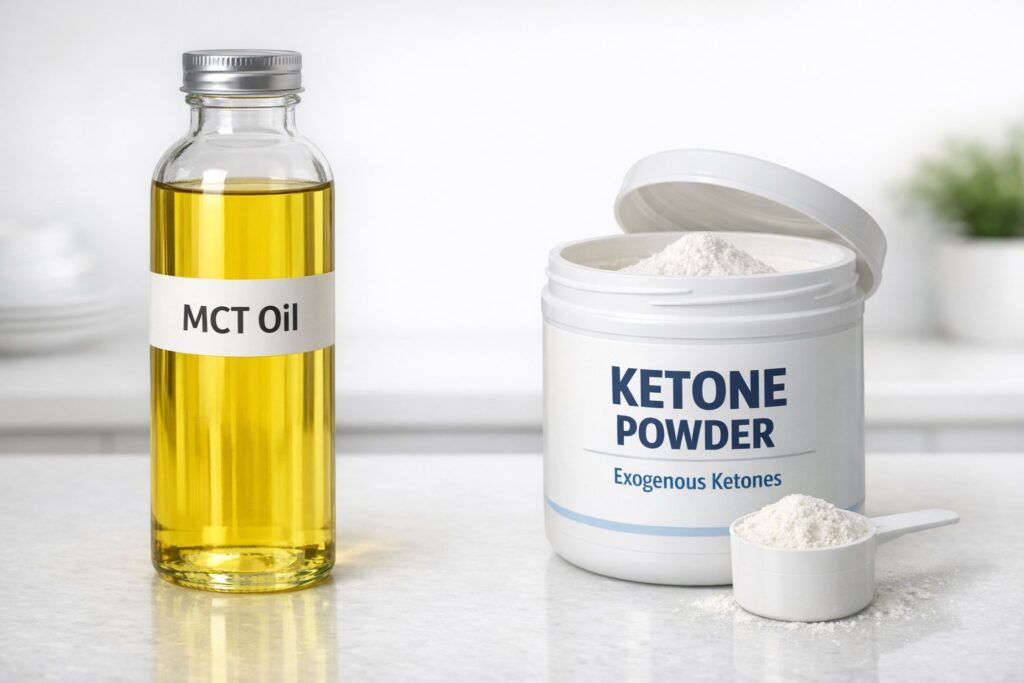
MCT oil and exogenous ketones both affect ketone availability, but they do so through different mechanisms.
Defining MCT Oil
MCT oil stands for medium-chain triglyceride oil. MCT oil is commonly derived from coconut or palm kernel oil and contains medium-chain fatty acids with 6–12 carbon atoms. These fatty acids are processed differently from many longer-chain fats.
After absorption, MCTs are transported to the liver, where they can be converted into ketones relatively quickly.
MCT oil is often used to increase ketone availability, although its effects on hunger, energy, and ketosis vary by individual.
Common types of MCTs include:
- C8 (caprylic acid): Converts to ketones the fastest
- C10 (capric acid): Gives balanced energy
- C12 (lauric acid): Digests more slowly and behaves more like a longer-chain fat.
Because MCTs are processed relatively quickly, MCT oil is commonly added to drinks or meals.
If you’re new to the keto lifestyle, our Beginner’s Guide to Ketogenic Diet explains how your body transitions into fat-burning mode.
Understanding Exogenous Ketones
Exogenous ketones are ketone bodies made outside your body and taken as supplements. You’ll usually see them as ketone salts or ketone esters. Both types can raise blood ketone levels without requiring the body to produce those ketones from dietary fat.
They’re designed to copy the effects of endogenous ketones—the kind your body makes during fasting or carb restriction. By increasing circulating ketones, they may provide an alternative fuel source for tissues such as the brain and muscles, although individual responses vary.
Key Differences Between MCT Oil and Exogenous Ketones
They both make more ketones available, but the way they do it couldn’t be more different. MCT oil gets your body to make ketones, while exogenous ketones just give them to you.
| Feature | MCT Oil | Exogenous Ketones |
|---|---|---|
| What it provides | Medium-chain fat | Ketone bodies |
| Primary action | Can increase your own ketone production | Raises circulating ketones directly |
| Requires ketogenesis? | Yes | No |
| Main immediate effect | Provides a rapidly metabolized fat source and may raise ketones | Rapidly increases blood BHB |
| Adds calories? | Yes | Depends on product/formulation |
| Automatically increases fat loss? | No | No |
| Typical reason to consider it | Supporting energy or ketone production | Raising ketones for a specific short-term purpose |
| Is it necessary for keto? | No | No |
MCT oil supports the body’s own ketone production, while exogenous ketones provide ketone bodies directly. These effects are different and should not be interpreted as proof of greater fat loss or faster keto adaptation.
Ketosis Is Not the Same as Fat Loss
Nutritional ketosis refers to a state in which the body is producing and using more ketones. Fat loss depends on a broader set of factors, including overall energy intake, dietary consistency, activity, sleep, and individual metabolic conditions.
MCT oil may support ketone production, while exogenous ketones may temporarily increase blood BHB. Neither result alone proves that more body fat is being lost. This distinction is important when evaluating whether a supplement is solving a real problem or simply changing a measurable ketone value.
How They Work: Mechanisms for Energy and Fat Loss
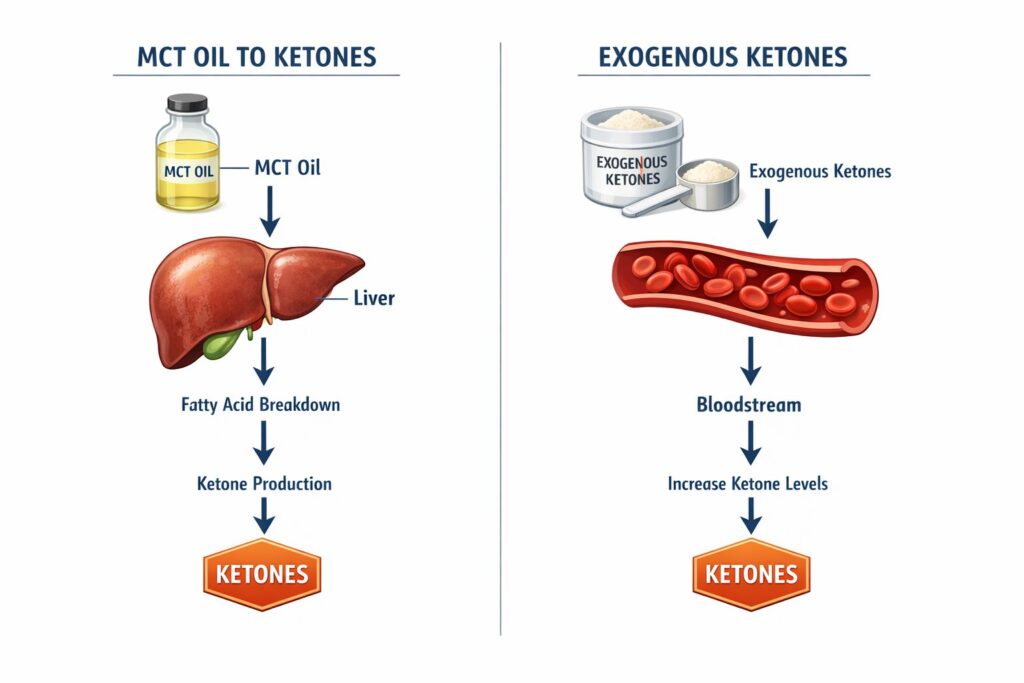
Both MCT oil and exogenous ketones can increase ketone availability, but this does not mean they produce the same metabolic effects or automatically increase stored-body-fat loss.
MCT oil contains medium-chain triglycerides, commonly including caprylic acid (C8) and capric acid (C10). These fats are processed relatively quickly by the liver and may support endogenous ketone production. The resulting ketones are produced by the body rather than supplied directly by the supplement.
Exogenous ketones work differently. Ketone salts and ketone esters provide ketone bodies from an outside source, commonly measured as beta-hydroxybutyrate (BHB). This can increase circulating blood ketone levels temporarily, but it does not necessarily indicate increased fat oxidation or greater use of stored body fat.
MCT Oil and Ketone Production
MCTs are fats that get absorbed and burned pretty fast. Unlike regular fats, they shoot straight to your liver via the portal vein and turn into ketone bodies like beta-hydroxybutyrate (BHB) and acetoacetate.
This process—ketogenesis—ramps up your own ketone production, even if you’re not super low on carbs. Since MCTs are burned for energy quickly, they’re less likely to end up as body fat.
MCT oil can help you stay in mild ketosis and keep your brain and muscles fueled. It might also give your metabolism a tiny nudge, which could help with fat loss if you’re eating right.
Main effects of MCT oil:
- Supports the liver’s ketone production
- May provide an additional source of rapidly available energy
- Does not guarantee greater fat burning or weight loss
Exogenous Ketones and Direct Ketosis
Exogenous ketone supplements put ketones straight into your bloodstream, usually as BHB salts or ketone esters. This skips the liver and gives you a quick spike in blood BHB levels.
By flooding your system with ketones, they can kind of mimic fasting or keto—at least for a bit. Your brain, heart, and muscles will use these ketones instead of glucose.
But here’s the thing: exogenous ketones don’t really make you burn more fat, since you’re just adding outside energy. They might help curb your appetite and keep blood sugar steady, but real fat loss still comes down to what you eat and how much you move.
Common forms:
| Type | Description | Duration |
|---|---|---|
| Ketone salts | BHB with minerals | Moderate, doesn’t last long |
| Ketone esters | Pure BHB | Stronger, lasts a bit longer |
Impact on Metabolism and Fat Burning
Both MCTs and exogenous ketones can make ketones available as a fuel source.
However, using ketones for energy is not the same as increasing the amount of stored body fat being burned. MCT oil provides a substrate that the liver can convert into ketones, while exogenous ketones supply ketone bodies directly. Neither should be treated as a standalone fat-loss strategy.
MCT oil provides a rapidly available fat source that the liver can convert into ketones, while exogenous ketones provide ketone bodies directly.
MCTs can bump up your calorie burn a little, but exogenous ketones mostly change what fuel your body uses, not how much you burn. In the end, your results depend on your diet, exercise, and how you use these supplements.
MCT Oil: What It Can and Cannot Do
MCT oil contains medium-chain triglycerides, a type of fat that is processed differently from many longer-chain dietary fats. The liver can absorb and convert MCTs into ketones relatively quickly, which is why MCT oil is often used as a way to increase ketone availability.
This does not mean that MCT oil automatically creates nutritional ketosis. Your overall carbohydrate intake, existing metabolic state, and individual response still influence how much ketone production occurs.
What MCT Oil May Help With
MCT oil may be useful in a few specific situations:
- Supporting ketone production: MCTs can provide a readily available substrate for the liver to produce ketones.
- Providing an additional energy source: Some people find that MCT oil provides a convenient source of energy, particularly when adapting to a lower-carbohydrate diet.
- Increasing dietary fat without relying entirely on long-chain fats: MCT oil can be incorporated into meals or drinks when additional fat is appropriate.
- Supporting certain ketogenic approaches: Some therapeutic ketogenic diets use MCTs because they can contribute to ketone production without requiring the same amount of dietary fat as other fats.
However, these potential uses should not be confused with guaranteed improvements in weight loss, energy, or keto adaptation.
What MCT Oil Cannot Do
MCT oil does not directly force the body to lose stored body fat. It also does not correct an overall diet that contains too many calories, excessive carbohydrate intake, inadequate protein, poor sleep, or inconsistent execution.
Adding MCT oil on top of an already sufficient diet may simply increase total calorie intake. Although MCTs may have modest effects on energy expenditure or body composition compared with some other fats, the effect is not large enough to make MCT oil a standalone weight-loss strategy.
MCT oil can also cause digestive discomfort, especially when introduced too quickly. Nausea, cramping, bloating, or diarrhea are possible, so tolerance matters when deciding whether it is appropriate.
The practical conclusion is that MCT oil is best understood as an optional tool for increasing ketone availability—not as a requirement for keto, a shortcut to fat loss, or a replacement for sound dietary execution.
If weight loss has stalled, review Hidden Carbs That Can Sabotage Your Keto Diet to check whether overlooked carbohydrates may be affecting your results.
Exogenous Ketones: What They Can and Cannot Do
Exogenous ketones are ketone bodies supplied from outside the body, usually in the form of ketone salts or ketone esters. Unlike MCT oil, they do not need to be converted from dietary fat before entering the bloodstream.
They can raise blood beta-hydroxybutyrate, or BHB, relatively quickly. However, this increase should not automatically be interpreted as proof that the body has entered deeper nutritional ketosis or is burning more stored body fat.
What Exogenous Ketones May Help With
Exogenous ketones may have limited usefulness in specific situations:
- Temporarily increasing circulating ketones: They can raise blood ketone levels without requiring the same process of endogenous ketone production.
- Providing an alternative fuel source: Some people may experience a temporary change in perceived energy or mental clarity, although responses vary.
- Supporting certain specialized uses: Exogenous ketones have been studied in areas such as exercise, cognitive performance, and therapeutic ketosis, but the evidence does not establish broad benefits for everyone following keto.
- Providing ketones when endogenous production is limited: They may increase ketone availability even when the body is not producing large amounts of ketones from its own stored or dietary fat.
These potential uses are narrower than many marketing claims suggest.
In many cases, what feels like low energy during keto may be related to electrolyte imbalance rather than insufficient ketone production.
What Exogenous Ketones Cannot Do
Exogenous ketones do not automatically increase fat loss. The ketones consumed are an external fuel source; their presence in the bloodstream does not prove that the body is releasing and burning more stored body fat.
They also do not replace the metabolic changes associated with sustained nutritional ketosis. A supplement can raise BHB temporarily without reproducing every effect of a well-established ketogenic diet.
Exogenous ketones cannot correct excessive carbohydrate intake, inadequate food intake, poor hydration, electrolyte issues, insufficient sleep, or inconsistent adherence. They should not be used to disguise an underlying problem that is preventing progress.
Why a Higher Ketone Reading Is Not Always Better
Blood ketone levels are only one measurement. A higher number may reflect the ketones recently consumed rather than a meaningful improvement in metabolic adaptation or fat loss.
For this reason, chasing higher BHB readings can create confusion. Someone may record elevated ketones while still experiencing fatigue, poor recovery, hunger, or stalled weight loss.
The practical conclusion is that exogenous ketones are an optional, situation-specific supplement. They may increase circulating ketones, but they are not required for nutritional ketosis and should not be treated as a shortcut to faster fat loss or better keto results.
Understanding where you are in your keto adaptation timeline may be more useful than using supplements to compensate for dietary inconsistencies.
Before Choosing a Ketone Supplement, Identify the Actual Problem
MCT oil and exogenous ketones may change ketone availability, but they do not address every problem people experience on keto.
Before choosing either supplement, identify what is actually limiting your progress.
If You Are Not Losing Weight
A lack of weight loss does not automatically mean that your ketone levels are too low. Other factors may include:
- consuming more calories than intended
- underestimating portion sizes
- hidden carbohydrates in sauces, drinks, or processed foods
- eating additional fat without accounting for its energy contribution
- inconsistent adherence during weekends or social occasions
- normal changes in water weight
In this situation, adding MCT oil may increase calorie intake without solving the reason weight loss has stalled. Exogenous ketones may raise blood BHB without increasing the amount of stored body fat being used.
The first step is to review food intake, consistency, and progress measurements before adding another supplement.
If You Feel Tired or Weak
Fatigue during keto may be related to the adaptation process, insufficient food intake, hydration, electrolyte balance, sleep, or another factor unrelated to ketone availability.
MCT oil or exogenous ketones may provide additional ketones, but that does not guarantee that the underlying cause of fatigue will improve.
If fatigue is persistent, severe, worsening, or accompanied by other concerning symptoms, it should not be treated as a supplement problem alone.
If You Are Worried That You Are Not “In Ketosis”
Blood ketone readings can be useful, but a single number does not provide a complete picture of keto progress.
MCT oil may support the body’s own ketone production, while exogenous ketones can raise blood BHB directly. These effects are different, and neither supplement is required simply to validate that you are following keto correctly.
A more useful assessment includes carbohydrate consistency, food quality, energy levels, hunger, recovery, and longer-term progress.
If You Want Better Workout Performance
The appropriate choice depends on the type of activity, training intensity, food intake, and individual response. Neither supplement should be assumed to improve performance automatically.
Before experimenting with ketone products, review basic factors such as adequate nutrition, hydration, sleep, training volume, and recovery. These often have a greater influence on performance than the choice between two ketone supplements.
The key principle is simple: a supplement should be selected to address a specific, well-defined need—not used as a general solution for unclear keto problems.
Types and Sources: MCT Oil and Exogenous Ketones Compared
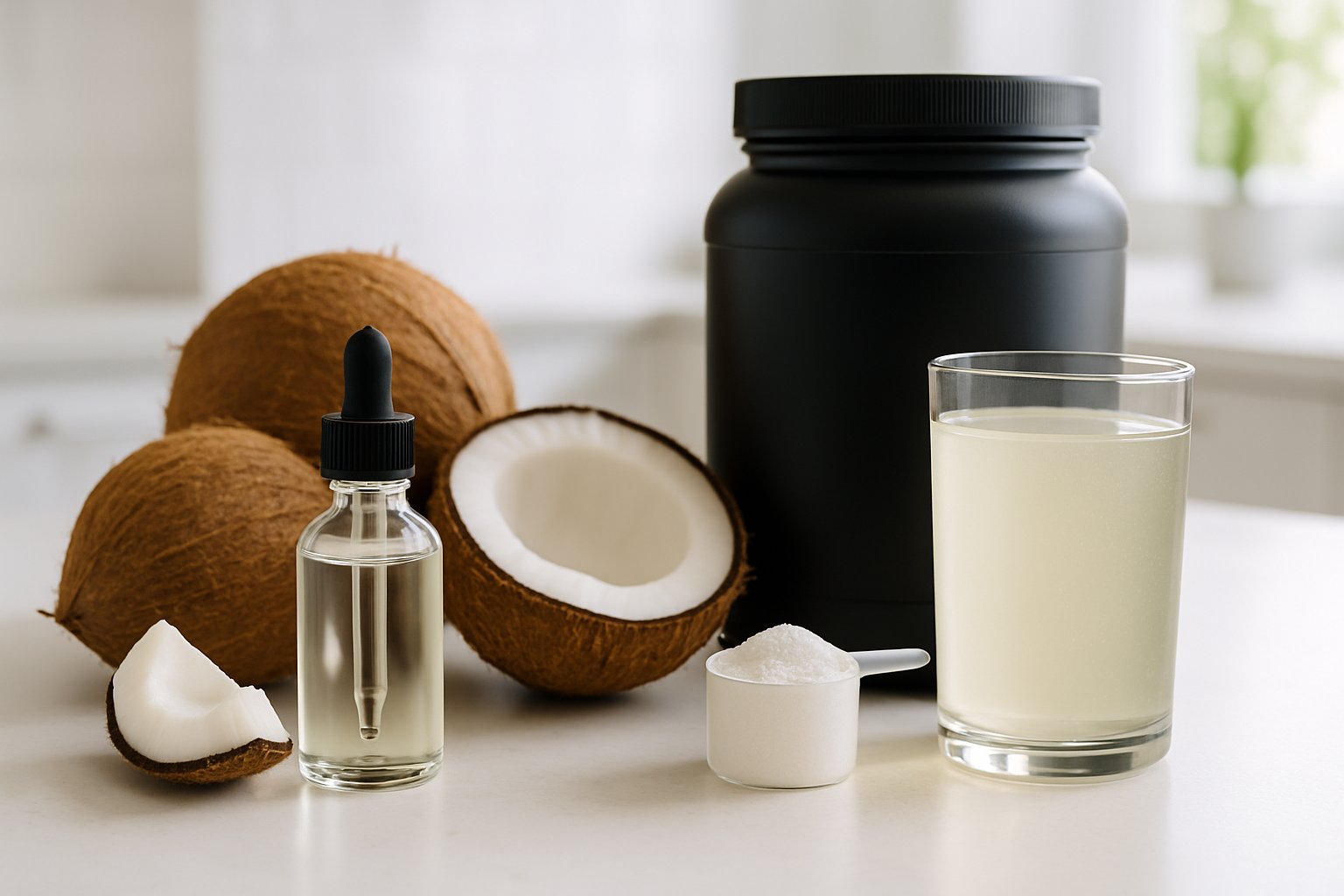
MCT oil and exogenous ketones aren’t quite the same thing. MCT oil has special fats that your liver turns into ketones, while exogenous ketones are basically ready-to-go ketones in supplement form.
Their sources and chemical details change how well they support your energy and fat metabolism. It’s not always obvious which one will work best for you until you try them.
Fatty Acid Composition in MCT Oil
Medium-chain triglycerides (MCTs) are fats with 6–12 carbon atoms. The main players are caproic acid (C6), caprylic acid (C8), capric acid (C10), and lauric acid (C12).
C8 MCT oil (caprylic acid) converts to ketones faster than the others, so it’s popular for quick energy. Capric acid (C10)helps too, just not as quickly. Lauric acid (C12) digests more slowly, acting more like a long-chain fat and giving a longer-lasting effect.
MCTs occur naturally in foods such as coconut oil, palm kernel oil, and dairy fat, although the proportions and types of MCTs vary. Refined MCT oil supplements provide a more concentrated source of selected medium-chain fatty acids, particularly C8 and C10.
| Fatty Acid | Carbon Length | Common Name | Conversion Speed to Ketones |
|---|---|---|---|
| C8 | Caprylic acid | Very fast | High |
| C10 | Capric acid | Fast | Moderate |
| C12 | Lauric acid | Slower | Low |
Forms of Exogenous Ketone Supplements
Exogenous ketones mainly come as ketone salts or ketone esters. Both boost blood ketones, but your body handles them a bit differently.
Ketone salts are beta-hydroxybutyrate (BHB) combined with minerals like sodium, calcium, or magnesium. They’re easier to take and taste better, but too much can bother your stomach.
Ketone esters are compounds in which a ketone body is linked to an alcohol molecule. They can produce different blood-ketone responses from ketone salts, but suitability depends on the product, purpose, tolerance, and individual circumstances.
| Type | Composition | Effect Duration | Typical Use |
|---|---|---|---|
| Ketone Salts | BHB + Minerals | Moderate | Short-term ketone availability |
| Ketone Esters | BHB + Alcohol | Short but strong | Short-term ketone availability |
Natural vs Supplemental Sources
MCT oil is found in nature—think coconut oil, palm oil, and butter—so you can get it from your regular food. MCT oil supplements just concentrate the most useful fatty acids for a quicker effect.
Exogenous ketones are produced outside the body and supplied through supplements such as powders, drinks, or capsules.
Food sources and supplements differ in their composition, concentration, and rate of ketone availability. The effect depends on the specific source and individual response.
Side Effects and Safety Considerations
MCT oil and exogenous ketones are not risk-free. The main considerations are digestive tolerance, the amount used, the ingredients in the product, and whether an underlying medical condition or medication could affect how the supplement should be used.
Neither supplement is required for a ketogenic diet. If you are considering one, start by identifying the specific problem you want to address rather than assuming that a higher ketone level is automatically better.
Digestive Issues and Tolerance
MCT oil can cause gastrointestinal symptoms, particularly when a person uses too much at once. Possible reactions include:
- Diarrhea
- Nausea
- Bloating
- Stomach cramps
- General abdominal discomfort
Using a smaller amount and increasing gradually, if tolerated, may reduce the likelihood of digestive problems. Taking MCT oil with food may also be easier on the stomach than taking it by itself.
Exogenous ketones can also cause digestive discomfort. Depending on the product and serving size, possible reactions include nausea, bloating, cramping, or diarrhea. Some ketone products contain additional ingredients, sweeteners, or mineral salts that may contribute to these effects.
If symptoms occur, reduce or stop the supplement rather than continuing to increase the amount.
Mineral and Ingredient Considerations
Many exogenous ketone products are formulated as ketone salts. These may contain minerals such as sodium, potassium, calcium, or magnesium. The amount varies by product, so the label should be checked rather than assuming that all ketone supplements have the same composition.
This matters for people who need to monitor mineral or electrolyte intake. A supplement may add a meaningful amount of sodium or other minerals to the diet, especially when used repeatedly or combined with other electrolyte products.
MCT oil does not contain the same mineral load, but it is still calorie-dense. Adding it without considering total food intake may increase daily calories and make weight-management goals more difficult.
When to Use Extra Caution
Speak with a qualified healthcare professional before using MCT oil or exogenous ketones if you:
- Have kidney, heart, or metabolic health concerns
- Take medication that affects blood glucose, blood pressure, fluid balance, or electrolytes
- Have been advised to limit sodium, potassium, or other minerals
- Are pregnant or breastfeeding
- Are using a medically supervised ketogenic diet
- Experience persistent weakness, dizziness, palpitations, vomiting, or other unexplained symptoms
Supplements should not be used to mask symptoms that may have another cause. Fatigue, poor exercise tolerance, dizziness, or difficulty adapting to keto may be related to inadequate food intake, hydration, electrolytes, sleep, medication effects, or another health issue.
A Practical Safety Rule
Use the lowest amount necessary for a clearly defined purpose, assess your individual tolerance, and avoid combining multiple products simply to raise ketone levels further.
If a supplement causes repeated side effects or does not address the problem you intended to solve, there is no strong reason to continue using it.
Why Supplements Cannot Fix a Poor Keto Foundation
Many people turn to MCT oil or exogenous ketones hoping to accelerate results, but supplements cannot compensate for fundamental keto mistakes.
If carbohydrate intake remains too high, calorie intake is inconsistent, or electrolyte balance is neglected, progress may stall regardless of which supplement is used.
In most cases, correcting the underlying diet structure has a greater impact on fat loss and ketosis than relying on supplements to get into ketosis faster.
Which Is Better for Energy and Fat Loss?
Neither MCT oil nor exogenous ketones is automatically better for everyone. The more appropriate option depends on the problem you are trying to solve and whether that problem is actually related to ketone availability.
MCT oil may be useful when the goal is to provide medium-chain fats that the liver can convert into ketones. However, it adds calories and does not guarantee greater fat loss, sustained energy, or faster keto adaptation.
Exogenous ketones may be useful when the specific goal is to temporarily increase circulating ketone levels. This does not necessarily mean that the body is burning more stored fat, and the effect does not replace consistent dietary habits.
For most people, the more important factors are adequate food intake, appropriate carbohydrate control, sufficient protein, hydration, electrolyte management, sleep, and a sustainable overall keto structure.
If weight loss or energy remains inconsistent despite using supplements, review the underlying keto approach before adding more products. The problem may involve execution, calorie intake, adaptation, recovery, or another factor that a ketone supplement cannot correct.
The practical question is therefore not:
Which supplement produces more ketosis?
It is:
Does either supplement address the specific problem I am experiencing?
Frequently Asked Questions
What is the main difference between MCT oil and exogenous ketones?
MCT oil provides medium-chain fats that the liver can convert into ketones. Exogenous ketones provide ketone bodies directly and can temporarily increase blood ketone levels.
MCT oil therefore supports the body’s own ketone production, while exogenous ketones provide ketones from an outside source. Neither approach automatically produces greater fat loss or faster keto adaptation.
Does a higher blood ketone level mean greater fat loss?
No. Blood ketone levels and body-fat loss are related to different processes.
Exogenous ketones can temporarily raise blood BHB without proving that the body is burning more stored fat. MCT oil may increase ketone production, but it also adds calories.
For weight management, the overall dietary pattern, energy intake, consistency, activity, sleep, and recovery matter more than trying to achieve the highest possible ketone reading.
Can MCT oil or exogenous ketones fix keto fatigue?
Not necessarily. Fatigue during keto may be related to adaptation, inadequate food intake, hydration, electrolyte balance, sleep, training demands, or another underlying issue.
MCT oil and exogenous ketones may affect ketone availability, but they do not correct every possible cause of fatigue. If symptoms persist, review the underlying issue rather than automatically increasing supplementation.
Can You Take MCT Oil and Exogenous Ketones Together?
Yes, MCT oil and exogenous ketones can be used together, but combining them is not automatically more effective than using either one alone.
MCT oil provides medium-chain fats that the liver can convert into ketones. Exogenous ketones provide ketone bodies directly and can temporarily raise blood BHB.
Using both may increase total ketone availability, but it also increases the amount of supplementation and may increase the risk of digestive discomfort. The combination does not guarantee greater fat loss, better performance, or faster keto adaptation.
If you are considering both, first identify the specific reason for using each one. If there is no clear purpose, adding both may simply increase cost and complexity without solving the underlying problem.
Do you need either supplement to follow a ketogenic diet?
No. A ketogenic diet can be followed without MCT oil or exogenous ketones.
Some people may choose MCT oil for an additional source of medium-chain fat, while others may use exogenous ketones for a specific short-term purpose. These are optional tools, not requirements for entering ketosis, losing fat, or adapting to a ketogenic diet.
Conclusion
MCT oil and exogenous ketones both affect ketone availability, but they do so in different ways. MCT oil supplies medium-chain fats that the liver can convert into ketones, while exogenous ketones provide ketone bodies directly and can temporarily raise blood BHB.
Neither supplement is required for a ketogenic diet, and neither guarantees greater fat loss, faster keto adaptation, or better performance. MCT oil adds calories, while exogenous ketones may change blood ketone levels without proving that the body is burning more stored fat.
The more useful choice depends on the specific problem you are trying to solve. If your progress is inconsistent, review your food intake, carbohydrate control, hydration, electrolytes, sleep, recovery, and overall adherence before assuming that you need more ketones.
If you want a more structured approach to planning and consistency, Keto Creator offers a personalized keto plan that may help reduce guesswork.