
Keto Adaptation Stages: What Really Happens When You Go Keto
Starting keto often produces dramatic early changes — rapid weight shifts, fatigue, cravings, and mental fluctuations.
What most people do not realize is that keto adaptation moves through predictable metabolic stages.

Each stage produces different physical and hormonal responses. When those responses are misunderstood, people assume the diet is failing — when the body is simply transitioning.
This article breaks down the exact stages of keto adaptation, what normally happens in each phase, and how to tell the difference between temporary adjustment and true execution error.
What Keto Adaptation Actually Means
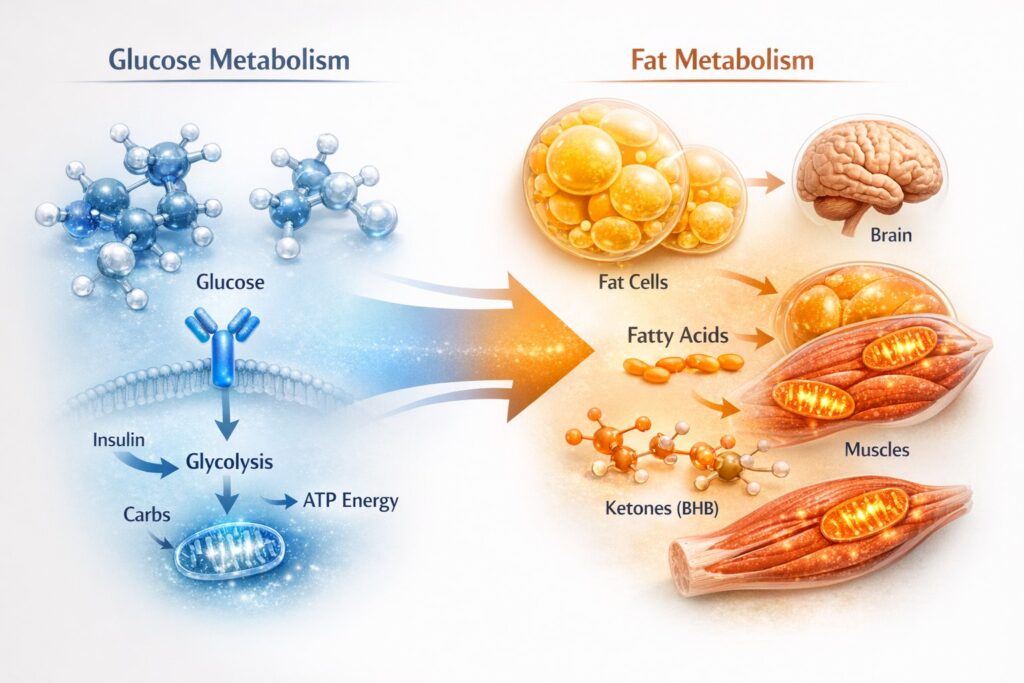
Keto adaptation is the metabolic transition that occurs when the body shifts from relying primarily on glucose to using fat and ketones as its dominant fuel source.
This process affects hormone signaling, enzyme activity, mitochondrial efficiency, appetite regulation, and energy stability.
Producing ketones can happen within days.
Efficiently using them takes longer.
Adaptation is not an event — it is a staged biological process.
Ketosis vs Fat Adaptation
Ketosis begins when carbohydrate intake drops low enough for the liver to produce measurable ketones.
Fat adaptation is the later stage where the body becomes efficient at oxidizing fatty acids and ketones for sustained energy.
You can enter ketosis in a few days.
Full fat adaptation requires weeks of consistent metabolic exposure.
Ketosis is a fuel state.
Adaptation is a metabolic upgrade.
Confusing these two stages is one of the primary reasons people believe keto “stopped working” too early.
Why Stage Confusion Creates False Failure
Most early keto “failures” are not metabolic failures.
They are expectation failures.
People expect continuous scale drops after the first week.
They expect steady energy immediately.
They expect hunger to disappear permanently.
But adaptation unfolds in phases. Each phase feels different.
When people interpret transitional symptoms as dysfunction, they change strategies too early — often disrupting the adaptation they were waiting for.
Stage 1 — Glycogen Depletion (Days 1–3)
Why Rapid Weight Loss Is Mostly Water
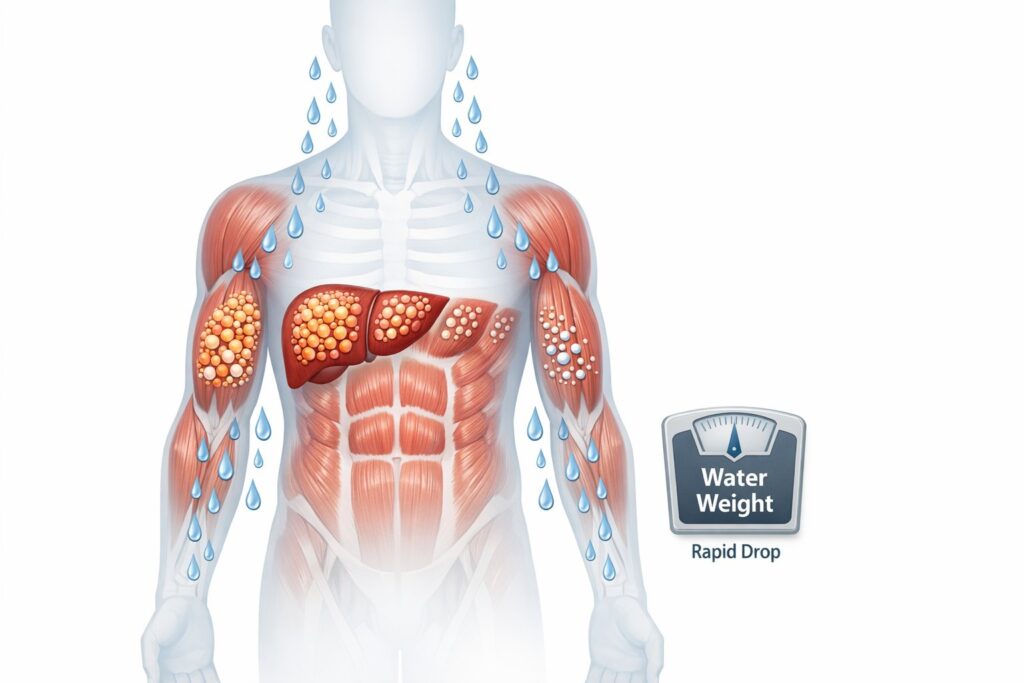
During the first 1–3 days, the body depletes stored glycogen from the liver and muscles.
Glycogen binds water.
As it is used, water is released and excreted.
This is why rapid early weight loss is primarily fluid — not fat.
Insulin levels fall quickly during this phase, signaling increased fat breakdown. However, the body is not yet efficient at using fat for sustained energy.
Fatigue during this stage reflects fuel switching — not metabolic resistance.
Early Fatigue Explained
Early fatigue in Stage 1 is primarily the result of glucose withdrawal and rapid fluid shifts.
Energy feels unstable because the body has reduced glucose availability but has not yet optimized ketone utilization.
This phase is short-lived when hydration and sodium intake remain adequate.
Stage 2 — Electrolyte Shift & Ketone Production (Days 4–10)
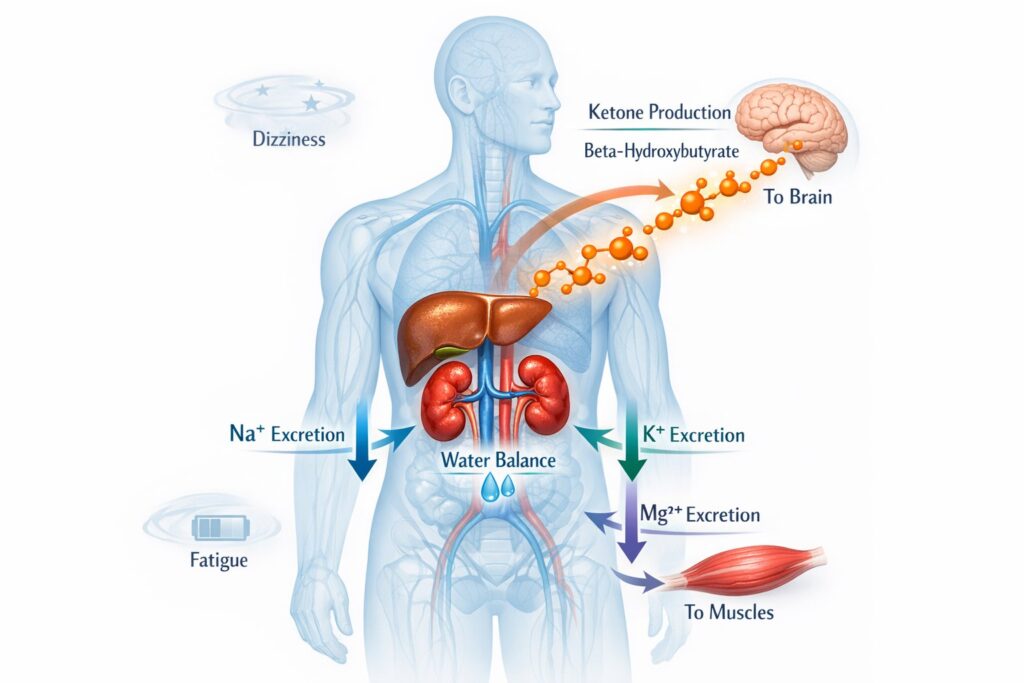
As glycogen depletion stabilizes, ketone production increases.
At the same time, insulin remains low — causing the kidneys to excrete sodium, potassium, and water more aggressively.
This electrolyte shift is responsible for most symptoms labeled as “keto flu.”
Headaches
Muscle cramps
Dizziness
Brain fog
Low training tolerance
These symptoms are not signs that keto is failing.
Many of these early symptoms match common keto flu symptoms that resolve once hydration and electrolyte levels stabilize.
They are signs that fluid and mineral balance has not yet stabilized.
When hydration and electrolytes are corrected, most individuals see symptom improvement within days.
Low insulin increases renal sodium excretion, which triggers downstream potassium and fluid shifts that directly affect blood pressure, muscle contraction, and neural signaling.
Keto Flu vs True Intake Error
Keto flu is temporary and improves with hydration and time.
True intake error presents differently:
• Persistent energy crashes beyond 2–3 weeks
• Reactive hunger
• Ongoing scale stagnation
• Hidden carbohydrate intake
• Excess dietary fat replacing body fat loss
Understanding this distinction prevents premature strategy changes.
Appetite and Mood Instability
During Stage 2, appetite hormones recalibrate.
Some people experience suppressed hunger.
Others notice rebound cravings.
Cortisol fluctuations can temporarily increase water retention, making scale progress appear inconsistent.
This is transitional — not structural.
Persistent fatigue during adaptation is often linked to hydration mistakes that slow fat loss rather than true metabolic resistance.
Stage 3 — Metabolic Transition (Weeks 2–4)
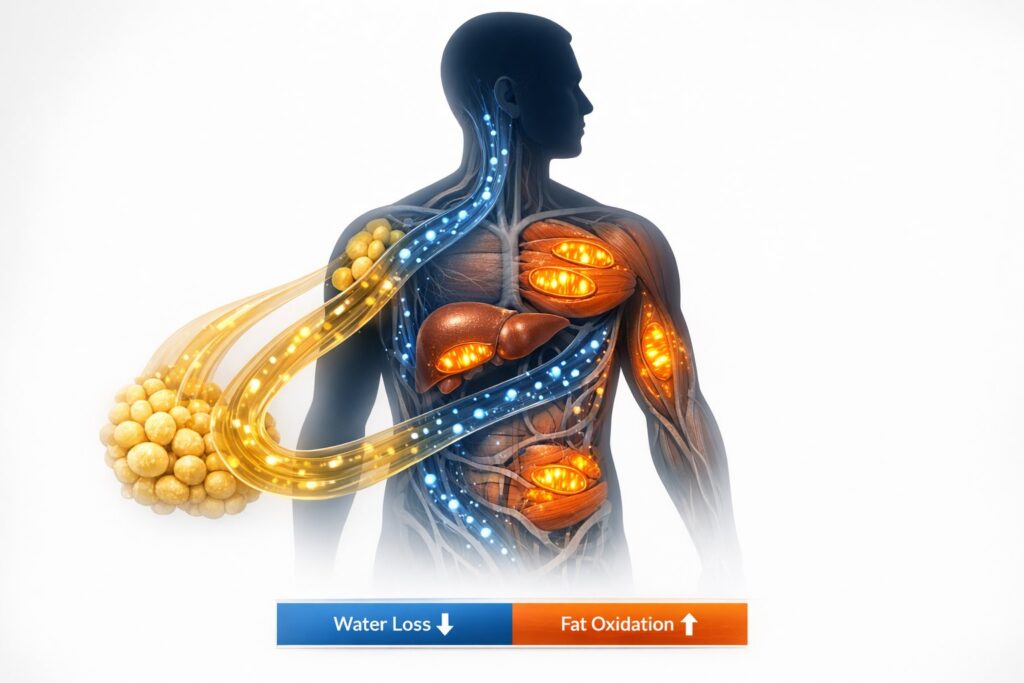
Weeks two through four represent the metabolic transition phase.
Fat oxidation capacity increases.
Mitochondrial efficiency improves.
Energy becomes more stable.
However, visible fat loss may slow compared to the dramatic water drop of week one.
This phase represents enzymatic up regulation — not fat-loss acceleration. The internal shift precedes visible tissue change.
This is where many people misinterpret normal adaptation as stagnation, which is why understanding when keto typically starts producing visible changes is critical.
When Fat Oxidation Becomes More Stable
During this phase, the body becomes more efficient at mobilizing stored fat rather than relying primarily on dietary fat intake.
Energy stability improves.
Workout tolerance gradually returns.
Hunger regulation becomes more predictable.
Why the Scale Often Slows Here
The early water loss phase has ended.
True fat loss progresses more slowly and does not present as dramatic daily drops.
Temporary stalls during weeks 2–4 are common and do not automatically indicate intake failure.
For a deeper breakdown of how each phase unfolds, see the full keto adaptation timeline analysis.
Stage 4 — Full Fat Adaptation (Weeks 4–6+)
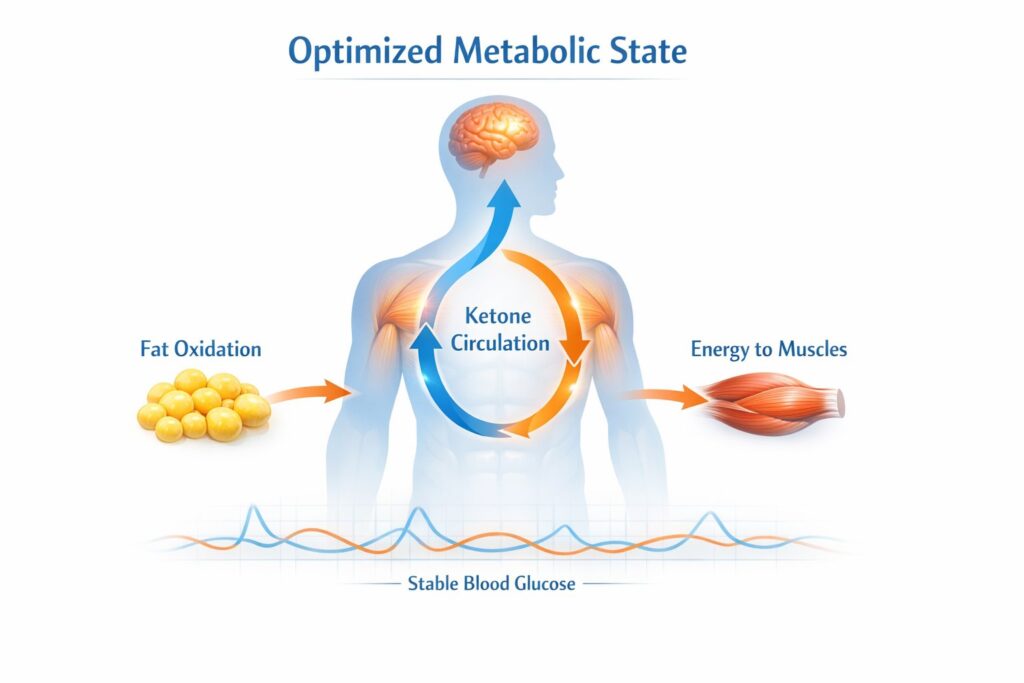
By weeks four to six, most metabolically consistent individuals reach full fat adaptation.
The body efficiently oxidizes fatty acids and ketones for sustained energy.
Blood sugar variability decreases.
Hunger stabilizes.
Mental clarity often improves.
Endurance performance becomes more predictable.
This stage reflects metabolic efficiency — not just ketone presence.
Signs of True Adaptation
Long-term keto adaptation leads to more metabolic flexibility. Your body learns to switch between burning fat and glucose depending on what’s available.
Indicators of true adaptation include:
• Stable energy without frequent snacking
• Reduced carb cravings
• Consistent appetite control
• Improved exercise recovery
• Less dramatic scale volatility
Performance and Mental Clarity Changes
As ketone utilization improves, many individuals report enhanced cognitive focus and reduced mental fatigue.
However, hydration, sleep, and adequate protein intake remain critical for sustained performance.
As adaptation progresses, some individuals must personalize your keto approach to align intake with their metabolic response.
What Is Normal vs What Signals a Problem

Understanding where you are in the keto adaptation stages prevents unnecessary overcorrection.
Not every stall means failure.
Not every symptom means something is broken.
The key is identifying whether your current pattern is transitional or structural.
Transitional Stall Patterns
These patterns are common during adaptation and usually resolve with consistency:
• Rapid water loss followed by scale slowdown
• Temporary fatigue during weeks 1–2
• Appetite fluctuation as hunger hormones recalibrate
• Minor water retention during weeks 2–4
• Gradual improvement in energy rather than immediate stability
In these cases, the body is still sequencing its metabolic shift.
The solution is stability — not restriction.
Red Flags That Require Intake Correction
These patterns usually indicate intake or lifestyle interference rather than adaptation delay:
• No measurable progress beyond six consistent weeks
• Persistent reactive hunger
• Frequent alcohol intake
• Hidden carbohydrate exposure
• Excess dietary fat replacing body fat loss
• Chronic sleep restriction or high stress load
Here, the issue is rarely the adaptation timeline itself.
It is usually a structural misalignment in intake, recovery, or lifestyle execution.
If your symptoms match transitional patterns, time and consistency are appropriate.
If they match structural patterns, review intake structure, sleep, stress, and alcohol exposure before assuming keto is ineffective.
Correct diagnosis prevents false abandonment and eliminates unnecessary dietary overcorrection.
If your progress remains unstable beyond the expected adaptation window, the diagnostic breakdown in Why Keto Is Not Working for Me: 7 Reasons Personalized Plans Succeed clarifies whether the issue is stage-based transition or structural intake misalignment.
Diagnostic Summary — Where Are You in the Process?
Keto adaptation follows a predictable sequence:
Days 1–3: Glycogen depletion and water release
Days 4–10: Electrolyte shifts and rising ketones
Weeks 2–4: Metabolic transition
Weeks 4–6+: Full fat adaptation
Temporary instability is normal.
Persistent non-response requires structural review — not immediate abandonment.
Correctly identifying your stage prevents false failure narratives and unnecessary structural overcorrection.
If repeated adaptation stalls persist despite consistent execution, building a personalized structure removes the guesswork.