
Keto Diet for Night Shift Workers: Meals, Timing, and Consistency
Following a keto diet for night shift workers requires more than choosing low-carbohydrate foods. When your working hours overlap with normal sleeping hours, conventional breakfast, lunch, and dinner schedules may not fit your actual routine.
Unpredictable breaks, limited workplace food options, changing shifts, and insufficient meal preparation can make it difficult to maintain consistent food choices. Trying to follow a rigid meal schedule designed around daytime work may create unnecessary friction.
This guide explains how to organize keto meals around your actual waking, working, and sleeping hours, prepare practical food options before a shift, and maintain a workable routine when schedules change. The goal is flexible dietary execution, not a medically prescribed eating schedule that everyone must follow.
Keto Diet for Night Shift Workers: Why Is It Harder to Maintain?

Keto while working nights is harder because the diet asks for planning, and an overnight work schedule removes many of the easy moments people use to plan. Daytime workers can grab a salad at lunch or cook dinner after work. You often have neither option.
Several keto night shift challenges tend to stack on top of each other:
- Irregular meal patterns. Your first meal may fall in the afternoon, and your last one may fall at 8 a.m. Standard meal plans do not map onto that.
- Workplace food availability. Many cafeterias close or shrink their menu overnight. What stays open tends to be vending machines and convenience stores, which lean heavily on bread, chips, and sweets.
- Unpredictable work breaks. In hospitals, warehouses, and public safety jobs, breaks get delayed or cut short. A meal that needs a microwave and 20 minutes may never get eaten.
- Rotating shift schedules. If you switch between days, evenings, and nights, your sleep and meal times move every week or two. A routine built for one schedule breaks on the next.
- Tiredness at the wrong moments. After a long shift, cooking feels like a big job. That is when grab-and-go carbs at home become most tempting.
A 2026 European survey of night-shift and day workers found that food choices among night workers were influenced by appetite, available time, and workplace food availability, highlighting the practical challenges of eating well during overnight schedules. You can review the SHIFT2HEALTH study of dietary behaviors among night-shift workers.
None of these problems means keto is a poor fit for you. They mean your plan has to account for timing, preparation, and access, since willpower alone will not cover a missed break at 3 a.m.
When food timing, work demands, and limited workplace choices repeatedly interfere with your routine, the difficulty may involve more than carbohydrate restriction alone. See Is Keto Hard to Stick To? for a broader look at common adherence barriers.
Triage — Where Does Your Night-Shift Keto Routine Break Down?
Use this quick check to find the weak point in your current routine.
Identify Your Main Night-Shift Eating Problem
Check each statement that sounds like you.
Timing
- You still try to eat “breakfast” in the morning, even after a night shift.
- You get very hungry around 2 to 4 a.m.
- You eat a large meal right before daytime sleep and sleep poorly.
Preparation
- You often leave for work without packed food.
- Your packed meal runs out before the shift ends.
- You cook only on days off, and the food is gone by midweek.
Workplace access
- Your only overnight choices are vending machines or a gas station.
- Missed or delayed meal breaks leave you grabbing whatever is fastest.
- You have no fridge or microwave you can count on.
Consistency
- Your routine works on fixed nights but falls apart after a schedule change.
- Days off look nothing like work days.
- You restart keto after every rotation.
The group with the most checks is your main problem. Start there.
Diagnostic Summary — What Is Causing Difficulty With Your Night-Shift Keto Routine?
Your triage results point to one of four causes. Fix the biggest one first, then move to the next.
Timing Problem — Your Meals Still Follow a Daytime Schedule
If you checked mostly timing items, your meals are tied to the clock instead of your day. Go to the meal timing section and rebuild around waking, shift start, and sleep.
Preparation Problem — Food Is Not Ready When You Need It
If you checked preparation items, you have a supply gap. The meals and snacks section and the preparation section will help you pack enough food for a full shift.
Workplace-Access Problem — Suitable Options Are Limited
If your workplace offers little you can eat, plan to bring nearly everything. The section on unpredictable breaks covers backup meals, storage, and how to handle a cafeteria or convenience store.
Consistency Problem — Your Routine Cannot Adapt to Changing Shifts
If your plan holds up on steady nights but breaks after a schedule change, go to the rotating shifts section. You need a system that moves with you.
If workplace scheduling and daily routines are making keto difficult to maintain, the broader diagnostic framework in Why Keto Is Not Working for Me can help you examine the wider execution problems.
→ Why Keto Is Not Working for Me
How Should You Time Keto Meals Around Work and Sleep?

Time your keto meals around what you are doing, and forget the labels “breakfast,” “lunch,” and “dinner.” Your eating schedule as a night worker works best when each meal has a job: fuel you after waking, carry you through the shift, or settle you before sleep.
Use Waking Time, Shift Start, and Sleep Time as Your Main Anchors
Pick three anchor points each day:
| Anchor | What it means | Meal role |
|---|---|---|
| Waking time | When you get up, even if it is 3 p.m. | Your first meal of the day |
| Shift start | When work begins | A solid meal shortly before |
| Sleep time | When you go to bed after work | A light option, if you need one |
When your waking-time meal and pre-shift meal fall close together, you can merge them into one larger meal. What you want is a schedule built on your real day.
Building a routine around waking rather than conventional clock times can make meal planning more practical. This general guide to the Keto Morning Routine offers additional context about structuring habits around the start of your waking day.
Plan a Satisfying Meal Before Your Shift
Your pre-shift meal does the most work. Eat it one to two hours before you leave, and make it your largest meal.
Build it around a good serving of protein, such as chicken thighs, eggs, ground beef, or salmon, with low-carb vegetables and some fat from olive oil, butter, cheese, or avocado.
A full plate here makes the overnight hours easier and cuts down on vending-machine trips.
Decide What to Eat During the Overnight Shift
Overnight meal timing is where general shift-work advice and keto meet. Workplace health guidance from NIOSH (the federal agency that studies worker health) suggests shift workers avoid or reduce eating between midnight and 6 a.m., since the body may be less ready to digest food at those hours.
That advice applies to shift workers in general. It does not prove anything specific about keto, and it is not a rule against ever eating at night.
In practice, many people do well with one modest meal or a couple of small snacks during the shift. Use your own hunger and digestive comfort as a guide.
If a big meal at 3 a.m. leaves you sluggish or uncomfortable, make that meal smaller and move more food to your pre-shift meal. If you get shaky or can’t focus, a small protein snack is a reasonable answer.
Decide Whether You Need Food Before Sleeping
You may or may not need food before daytime sleep. The same NIOSH guidance suggests a small meal before day sleep to avoid waking up hungry, and avoiding large meals in the one to two hours before your main sleep.
For keto, that might be two hard-boiled eggs, a cheese stick with a few slices of turkey, or a cup of broth. If you sleep well without eating, skip it.
What Keto Meals and Snacks Work Well on a Night Shift?
The best keto meals for a night shift are simple, sturdy, and easy to eat cold or after a quick reheat. Fancy recipes tend to fail at 2 a.m. Plain ones hold up.
Build Practical Meals Around Protein, Low-Carb Vegetables, and Suitable Fat
Use a simple formula for each main meal:
- Protein (the base): chicken thighs, ground beef or turkey, pork, salmon, tuna, eggs, or tofu.
- Low-carb vegetables: broccoli, green beans, zucchini, cauliflower, spinach, cabbage, peppers, or salad greens.
- Fat: olive oil, butter, cheese, avocado, olives, or a full-fat dressing.
For practical meal portions, start with a palm-to-hand-sized serving of protein, a heaping cup or two of vegetables, and a tablespoon or two of added fat. Adjust from there based on how full you feel through the shift.
Choose Portable Meals That Are Easy to Eat During Short Breaks
Portable low-carb meals for work should be quick to eat with one hand or a fork. Good options include:
- Egg muffins (eggs baked with cheese and vegetables in a muffin tin)
- Chicken or tuna salad in a lettuce wrap or eaten straight from the container
- Burrito bowl without rice (seasoned ground beef, cheese, salsa, sour cream, lettuce)
- Cobb-style salad with chicken, egg, bacon, avocado, and dressing packed on the side
- Soup or chili without beans in an insulated container
- Sheet-pan sausage and vegetables, good cold or warm
Pick meals that taste fine at room temperature or cold. That way a broken microwave or a five-minute break does not leave you without food.
When food needs to travel with you, portable meals and snacks can make planning easier. See Keto on the Go for additional ideas that can be adapted to your workplace.
Select Snacks That Help Fill the Gaps Between Meals
Satisfying low-carb snacks keep you from hitting the vending machine. Aim for ones with protein or fat:
- Hard-boiled eggs
- String cheese or cheese cubes
- Beef jerky or meat sticks (check labels for added sugar)
- Almonds, walnuts, or pecans in a small pre-portioned bag
- Olives or pickles
- Deli turkey or ham rolled around cheese
- Celery or cucumber with cream cheese
- Plain Greek yogurt, if it fits your carb target
Pre-portion nuts at home. A full bag at 4 a.m. is easy to eat without noticing.
How Can You Prepare for Unpredictable Breaks and Limited Food Options?
Prepare for unreliable breaks by always carrying more food than you plan to eat, split into a main meal and a backup. Advance meal preparation is the single biggest tool you have for keto work meals.
Prepare a Main Meal and a Backup Food Option
Pack two things for every shift:
- Your main meal, eaten on your planned break.
- A backup that needs no fridge, no microwave, and no time.
Shelf-stable backup keto meals that can live in your locker or bag include canned tuna or salmon (in pouches if you lack a can opener), canned chicken, jerky, nuts, hard cheese, and pickles. Swap these out every few weeks so they stay fresh.
Batch-cook on a day off. Two proteins and two vegetables can cover several shifts when you mix and match them.
Preparing meals in advance can reduce last-minute decisions when work becomes busy. These Keto Meal Prep Ideas provide additional options for organizing food before your next shift.
Find Practical Keto-Compatible Choices at Work
When you have to buy food at work, look for these:
Workplace cafeteria options
- Grilled chicken or burger patty without the bun
- Salad bar with meat, eggs, cheese, and oil-based dressing
- Eggs and bacon or sausage, if breakfast is served overnight
- Steamed or roasted non-starchy vegetables
Convenience-store food choices
- Hard-boiled eggs
- Cheese sticks and snack packs of cheese
- Jerky and meat sticks
- Plain nuts
- Pre-made salads (skip croutons and sweet dressings)
- Pork rinds
- Sparkling water or unsweetened tea
Read labels on sauces, jerky, and flavored nuts, since added sugar shows up often.
People working long or demanding hours may face similar food-access problems even when their schedules are not overnight. This guide to the Keto Diet for Busy Professionals offers additional practical food-planning ideas.
Store and Transport Food Safely
Safe food storage and transport protects you from getting sick, which matters more on long shifts with no fridge. Follow USDA food safety basics:
- Keep perishable foods such as meat, eggs, and cheese cold. Food should not sit at room temperature for more than 2 hours, or 1 hour if it is above 90°F.
- Use an insulated, soft-sided lunch bag with at least two cold sources, such as two frozen gel packs, or one gel pack plus a frozen water bottle. Place them above and below the food.
- If a work fridge is available, put food in it when you arrive. If you put your whole bag in, leave it open so cold air reaches the food.
- For hot food like chili or soup, preheat an insulated container with boiling water for a few minutes, empty it, then add the piping-hot food. Keep it closed until you eat. Hot food should stay at 140°F or above.
- Reheat leftovers to at least 165°F. Cover food in the microwave so it heats evenly.
- Cook food ahead and chill it fully before packing. Pack your bag right before you leave.
- Throw out leftover perishable food after your shift.
Some foods need no cold source at all: hard cheese, canned meat and fish, whole vegetables, and pickles. These make strong backup choices.
What Could a Flexible Keto Routine Look Like for Night Shift Workers?
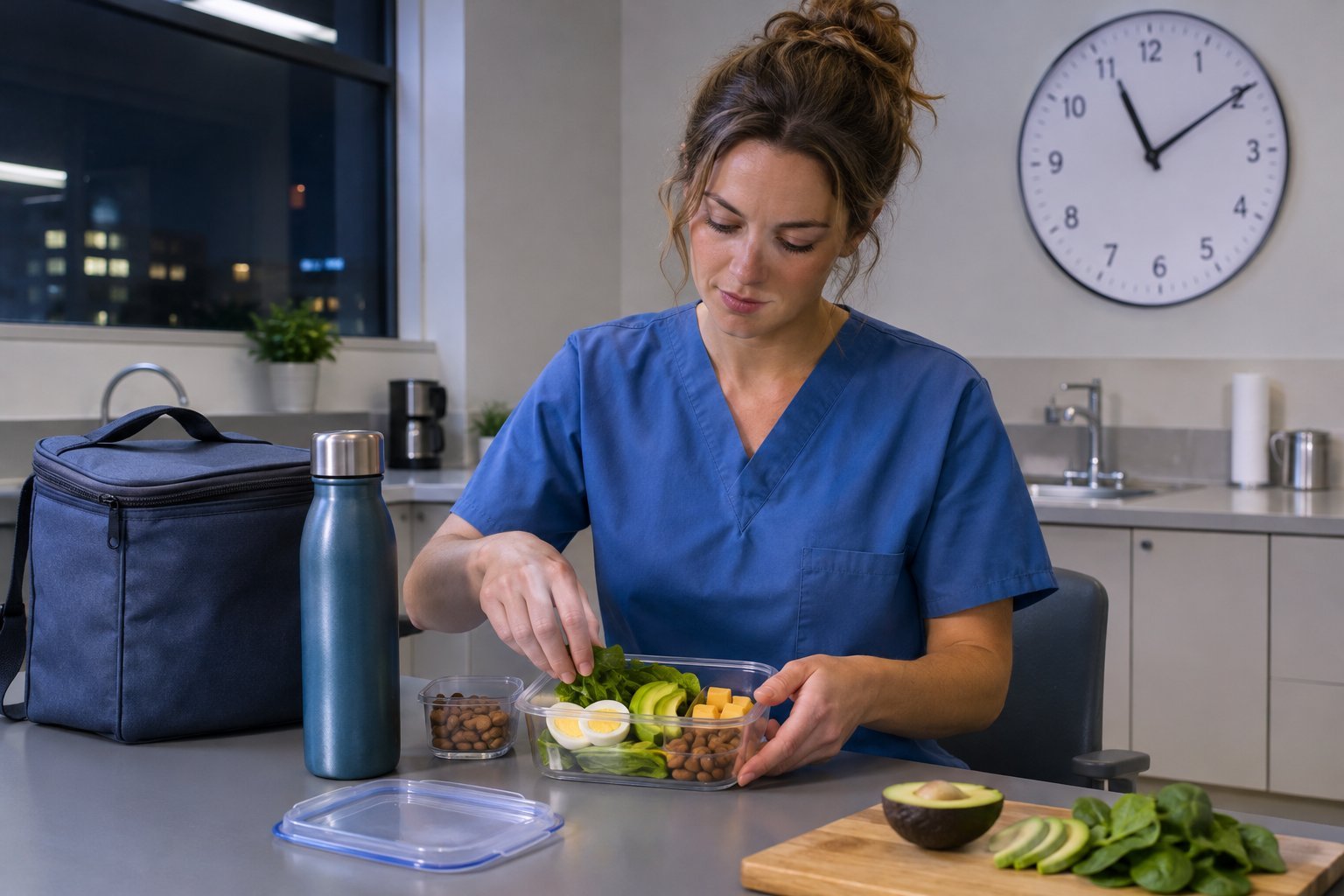
The examples below show how the earlier advice fits together. They are illustrations, not prescribed meal plans or medical protocols, so change them to fit your hunger, your job, and your sleep.
Example — A Fixed 7 p.m. to 7 a.m. Shift
This 12-hour night shift meal plan assumes you sleep from about 8:30 a.m. to 3:30 p.m.
| Time | Activity | Food |
|---|---|---|
| 3:30 p.m. | Wake up | Coffee or tea; eggs with sautéed spinach, or skip if not hungry |
| 5:30 p.m. | Pre-shift meal | Largest meal: salmon, roasted broccoli with butter, side salad |
| 7 p.m. | Shift starts | Water, unsweetened drinks |
| 11 p.m. to midnight | Main break | Chicken salad lettuce wraps, cucumber slices |
| 3 a.m. | Short break, if hungry | Cheese stick and a few almonds |
| 7 a.m. | Shift ends | Drive home |
| 7:45 a.m. | Before sleep, if needed | Two hard-boiled eggs or a cup of broth |
Most of the food lands before and early in the shift, with only light snacks in the small hours.
Example — A Shift With Short or Unpredictable Breaks
If you cannot count on a sit-down break, spread small amounts through the shift:
- Before work: a full, filling meal, since it may be your only real one.
- Pocket or locker: jerky, cheese, nuts, and a boiled egg or two.
- Any 5-minute gap: eat one or two items from your stash.
- If a long break shows up: eat your packed main meal, such as an egg-muffin batch or a beanless chili.
- After the shift: a small meal at home if the night left you short on food.
Here, short-break meal planning means food you can eat in a few bites without utensils.
Adapt the Examples to Your Own Schedule
To build your own version:
- Write down your wake time, shift start, and sleep time.
- Place your largest meal one to two hours before your shift.
- Pick one main meal for your longest likely break.
- Pack a backup that needs no fridge or heat.
- Decide whether you need a small bite before sleep.
Your individual eating routine may have two meals or four. Either works if it keeps you fed and steady through the night.
Having a simple meal framework can reduce daily food decisions, especially when work hours leave little time for preparation. The free 7-day Keto Meal Plan offers a general starting point that you can adapt to your own waking, working, and sleeping schedule.
How Can You Stay Consistent When Your Shifts Rotate?
You stay consistent on a rotating schedule by keeping the same system and the same core foods, while letting meal times move.
Keto with changing work hours works best when you stop expecting identical clocks from week to week.
Move Your Meal Anchors When Your Work and Sleep Schedule Changes
When your shifts change, your anchors change with them. On a day shift, your pre-shift meal might be at 5 a.m. On nights, it might be at 5 p.m.
The pattern holds: eat after waking, eat well before work, eat lightly before sleep if needed.
Transition days are the hardest. When you flip from nights to days, you may have a long or short “day.”
Keep a few easy foods on hand, like eggs, deli meat, and bagged salad, so you can eat when hungry without cooking.
When working hours change from week to week, it helps to have a flexible routine rather than rely on identical daily meal times. See How to Stay Keto When Life Gets Busy for additional strategies.
Prepare Food Around Your Next Work Block
Plan your shopping and cooking around your next stretch of shifts, not the calendar week. Before a block of three night shifts, for example:
- Shop on your last day off.
- Cook two proteins and two vegetables.
- Pack three main meals and three backups.
- Restock locker snacks.
Days off work well for cooking. Sleep-in days after a night block are a poor time to rely on yourself for complex meals, so keep frozen options ready, such as cooked meatballs or chili portions.
Keep Repeatable Food Choices Without Requiring Identical Meal Times
Repeatable food choices take decisions off your plate. Pick a short list of meals you like and rotate through them:
- Two or three main meals you batch-cook often
- Four or five reliable snacks
- One or two backup options that live at work
When your schedule shifts, you only have to answer one question: when to eat. What to eat is already settled. That makes a sustainable keto routine much easier to keep up across day, evening, and night rotations.
When Should You Adjust Your Keto Routine or Seek Advice?
Adjust your routine when it keeps causing problems, and get professional advice when symptoms or medications are involved.
Some trouble is normal. Ongoing trouble is a signal to change course, and pushing harder on the same plan rarely helps.
Recognize When Your Food Rules Have Become Too Restrictive
Restrictive eating patterns tend to creep in on night shifts. Watch for these signs:
- You skip food for a whole shift because nothing “fits.”
- You feel anxious or guilty after eating something off-plan.
- Your food list keeps shrinking.
- You turn down shared meals with coworkers because of rules.
If you see these, loosen up. A higher-carb meal on a hard night is a normal part of eating, and you can return to your usual pattern at the next meal.
Reassess Persistent Hunger, Fatigue, or Digestive Discomfort
Night work already strains sleep and energy, so it can be hard to tell what is causing what. Still, these deserve a closer look if they last more than a couple of weeks:
- Persistent hunger: you may need more protein or larger meals before your shift.
- Ongoing fatigue: look at total food intake, sleep, and work demands together.
- Digestive discomfort: try smaller overnight meals, fewer heavy or greasy foods during the shift, and more non-starchy vegetables.
If changes do not help, talk with a doctor or registered dietitian. Fatigue during night shifts has many possible causes, and a professional can help sort them out.
Discuss Diabetes, Medication Timing, and Low Blood Sugar Risk With a Clinician
If you have diabetes or take medicine that lowers blood sugar, talk with your clinician before starting or changing a keto diet. Insulin and certain pills, such as sulfonylureas and meglitinides, can cause low blood sugar.
Eating fewer carbs, or skipping and delaying meals (common on night shifts), raises that risk.
Your clinician can help you time meals and medication around your shifts. Low blood sugar can also happen during sleep, including daytime sleep, and signs can include sweating through sheets or waking up confused or irritable.
If you suspect low blood sugar, treat it right away. For blood sugar below 70 mg/dL or below your target, take 15 to 20 grams of fast-acting carbs (such as glucose tablets or 4 ounces of regular juice), wait 15 minutes, and recheck.
Staying in ketosis never comes before treating a low. Severe low blood sugar is an emergency; call 911 if someone cannot treat themselves.
Build a Keto Routine That Fits Your Next Shift
A keto routine on night shifts works when your meal prep, food choices, and meal timing match how you work and sleep. Anchor meals to waking, shift start, and sleep.
Make your pre-shift meal your biggest. Pack a main meal plus a backup that needs no fridge, and keep cold foods cold with two ice packs.
Before your next shift, do three things: write down your three anchor times, cook enough protein and vegetables to cover that work block, and stock your bag or locker with a few shelf-stable backups like tuna pouches, jerky, and nuts.
Once you understand your working and sleeping patterns, a structured keto meal plan may help organize suitable food choices around your preferences and daily routine. You can adapt the meal timing and preparation to your actual shifts.